Deep phenotyping is core aim of national immunodermatology consortium
In 2023, the Next Generation ImmunoDermatology (NGID) consortium was officially launched. With a grant of €11 million, NGID is dedicated to the deep phenotyping of six dermatological disorders, coordinated by CHDR's Dermatology group.
‘This is really huge for our group. The scale is so much bigger than what we can do as a small institute,’ says Prof. Robert Rissmann, Research Director of Dermatology. ‘We have invested a lot of energy into this grant application over the past few years - and now it has really paid off. The Dermatology departments of seven university medical centres in the Netherlands will work with us and industry partners on the deep phenotyping of six immunodermatology disorders, from molecules to people and their environment.’
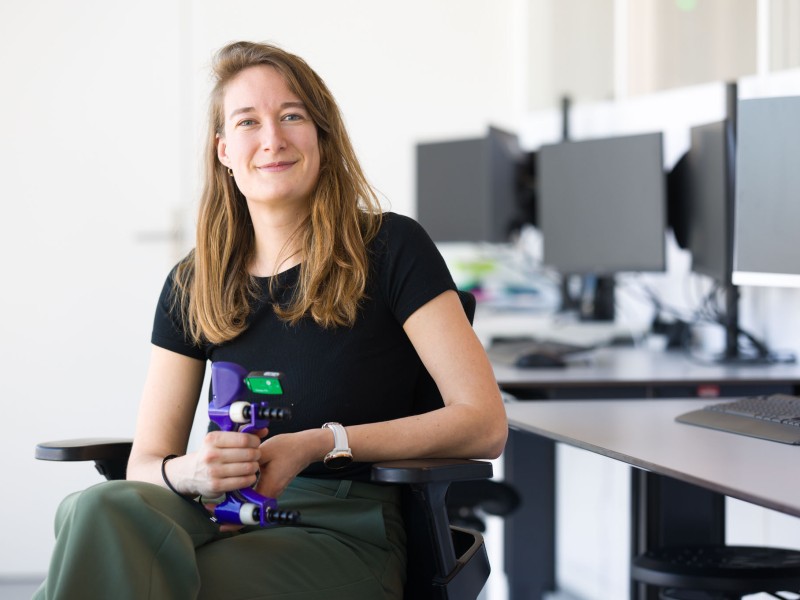
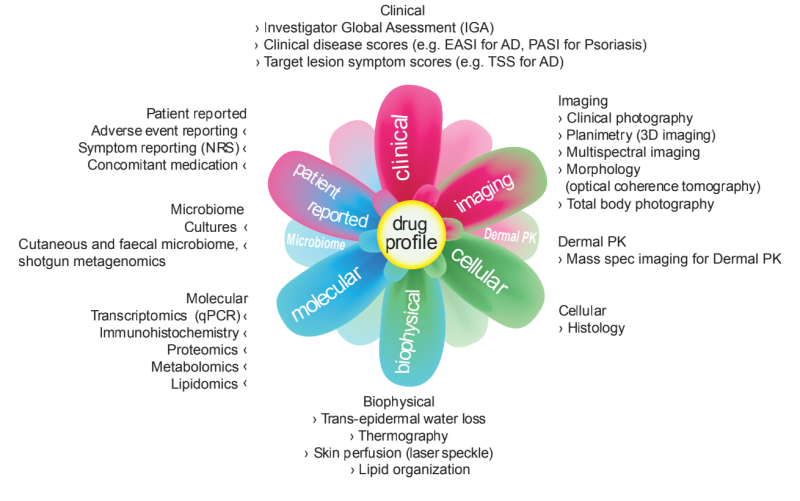
NGID’s phenotyping efforts combine objective measurements from CHDR’s DermaToolbox with clinical and psychosocial measurements to better understand each condition and its impact on patients’ lives. So the concept of the Dermaflower (pictured below) developed by Rissmann is now being widely applied, with the patient taking centre stage. Rissmann: ‘For us, it also means a slightly different perspective. As a pharmacologist, I’m used to putting the medicine at the forefront. But thanks to our collaboration, the patient receiving the treatment now becomes central.’
Drug development
Rissmann expects NGID will have significant implications for the development of new treatments in immunodermatology: ‘Deep phenotyping provides a wealth of information which offers leads for new drugs. This will be of great value for drug development in immunodermatology. And by putting the patient at the centre, we can connect as closely as possible to clinical practice and patients’ lifestyles. ‘Bridging the gap’, the theme of this Annual Report, is very relevant here because this project allows us to bridge many gaps: between laboratory and first-in-human studies, between early and late clinical drug development and between the well-controlled research setting and daily practice.’
Within CHDR, immunodermatology has been an important research theme for years, with Rissmann's Dermatology group and Dr Matthijs Moerland's Immunology group working closely together on the development of new drugs. This often involves immunomodulatory compounds that can also be used elsewhere in the body, for example in rheumatology. Rissmann: ‘The skin is our most visible and accessible organ, so it is well suited to provide a proof of principle for the efficacy of such an immunomodulatory drug.’
National infrastructure for trials
For dermatology, the consortium means a unique new approach to six very different conditions. The seven academic groups will focus on cutaneous T-cell lymphoma, atopic dermatitis, plaque psoriasis, urticaria, hidradenitis suppurativa, and cutaneous lupus erythematosus. A national infrastructure has been set up to handle the wealth of deep phenotyping data in a secure and accessible way. Rissmann: ‘We started recruiting and selecting PhD students in 2023 and setting up the collaboration in concrete terms. I am incredibly grateful that we have been awarded the grant. Looking ahead, I have high hopes for a rich scientific harvest with a large societal impact, that will benefit the lives of patients with dermatological diseases.’
Interested in learning more?
More articles from Developing methods